
Advocacy
Benjamin Rose Institute on Aging is committed to staying engaged in, and sharing, the latest public policy news affecting older adults, caregivers and the professionals who care for them. The Washington Update is produced monthly with our partners at Matz, Blancato & Associates to share the latest information about policy issues impacting older adults and their families.
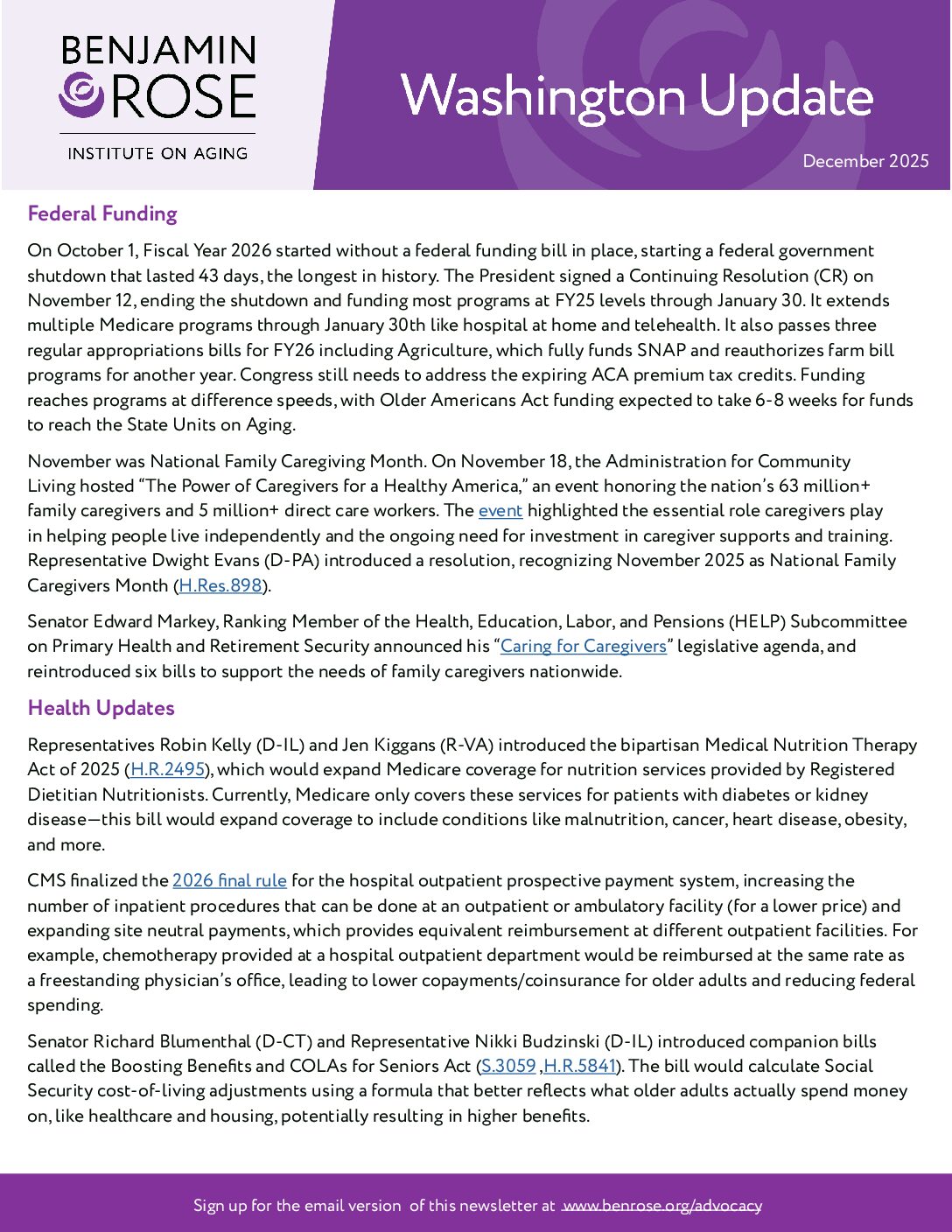
Federal Funding
On October 1, Fiscal Year 2026 started without a federal funding bill in place, starting a federal government shutdown that lasted 43 days, the longest in history. The President signed a Continuing Resolution (CR) on November 12, ending the shutdown and funding most programs at FY25 levels through January 30. It extends multiple Medicare programs through January 30th like hospital at home and telehealth. It also passes three regular appropriations bills for FY26 including Agriculture, which fully funds SNAP and reauthorizes farm bill programs for another year. Congress still needs to address the expiring ACA premium tax credits. Funding reaches programs at difference speeds, with Older Americans Act funding expected to take 6-8 weeks for funds to reach the State Units on Aging.
November was National Family Caregiving Month. On November 18, the Administration for Community Living hosted “The Power of Caregivers for a Healthy America,” an event honoring the nation’s 63 million+ family caregivers and 5 million+ direct care workers. The event highlighted the essential role caregivers play in helping people live independently and the ongoing need for investment in caregiver supports and training. Representative Dwight Evans (D-PA) introduced a resolution, recognizing November 2025 as National Family Caregivers Month (H.Res.898).
Senator Edward Markey, Ranking Member of the Health, Education, Labor, and Pensions (HELP) Subcommittee on Primary Health and Retirement Security announced his “Caring for Caregivers” legislative agenda, and reintroduced six bills to support the needs of family caregivers nationwide.
Health Updates
Representatives Robin Kelly (D-IL) and Jen Kiggans (R-VA) introduced the bipartisan Medical Nutrition Therapy Act of 2025 (H.R.2495), which would expand Medicare coverage for nutrition services provided by Registered Dietitian Nutritionists. Currently, Medicare only covers these services for patients with diabetes or kidney disease—this bill would expand coverage to include conditions like malnutrition, cancer, heart disease, obesity, and more.
CMS finalized the 2026 final rule for the hospital outpatient prospective payment system, increasing the number of inpatient procedures that can be done at an outpatient or ambulatory facility (for a lower price) and expanding site neutral payments, which provides equivalent reimbursement at different outpatient facilities. For example, chemotherapy provided at a hospital outpatient department would be reimbursed at the same rate as a freestanding physician’s office, leading to lower copayments/coinsurance for older adults and reducing federal spending.
Senator Richard Blumenthal (D-CT) and Representative Nikki Budzinski (D-IL) introduced companion bills called the Boosting Benefits and COLAs for Seniors Act (S.3059 ,H.R.5841). The bill would calculate Social Security cost-of-living adjustments using a formula that better reflects what older adults actually spend money on, like healthcare and housing, potentially resulting in higher benefits.
Elder Justice
Representatives Lori Trahan (D-MA), Jim McGovern (D-MA), and Debbie Dingell (D-MI) introduced the Protect Patients from Healthcare Abuse Act (H.R. 5895) to protect Medicare beneficiaries, including older adults, from abuse in healthcare settings. The bill requires Medicare providers to inform patients of their right to have a chaperone present during sensitive medical exams and their right to give informed consent before receiving care, and mandates staff training on supporting patients’ rights and reporting abuse.
Representatives Rob Menendez (D-NJ) and Erin Houchin (R-IN) introduced the Strategic Task Force on Scam Prevention Act (H.R. 5967) to create an interagency task force that will develop a national strategy to combat scams targeting consumers, particularly older adults. The bill directs the Federal Trade Commission and Department of Justice to coordinate with federal agencies, industry partners, and state law enforcement to improve public education, strengthen enforcement actions, enhance victim recovery resources, and report to Congress within one year.
The Department of Justice’s annual report to Congress was released. Federal prosecutors pursued more than 280 enforcement actions against over 600 defendants who targeted older Americans. National Elder Fraud Hotline received almost 63,000 calls in the past year. The four states with the highest number of calls were California, Florida, Texas and New York, with losses reaching almost $2 billion.
Events
On November 5, Senate Special Committee on Aging Chairman Rick Scott and Ranking Member Kirsten Gillibrand held a hearing on how the Older Americans Act supports families living with Alzheimer’s, Parkinson’s, and other aging-related diseases.
Washington Update Newsletters